
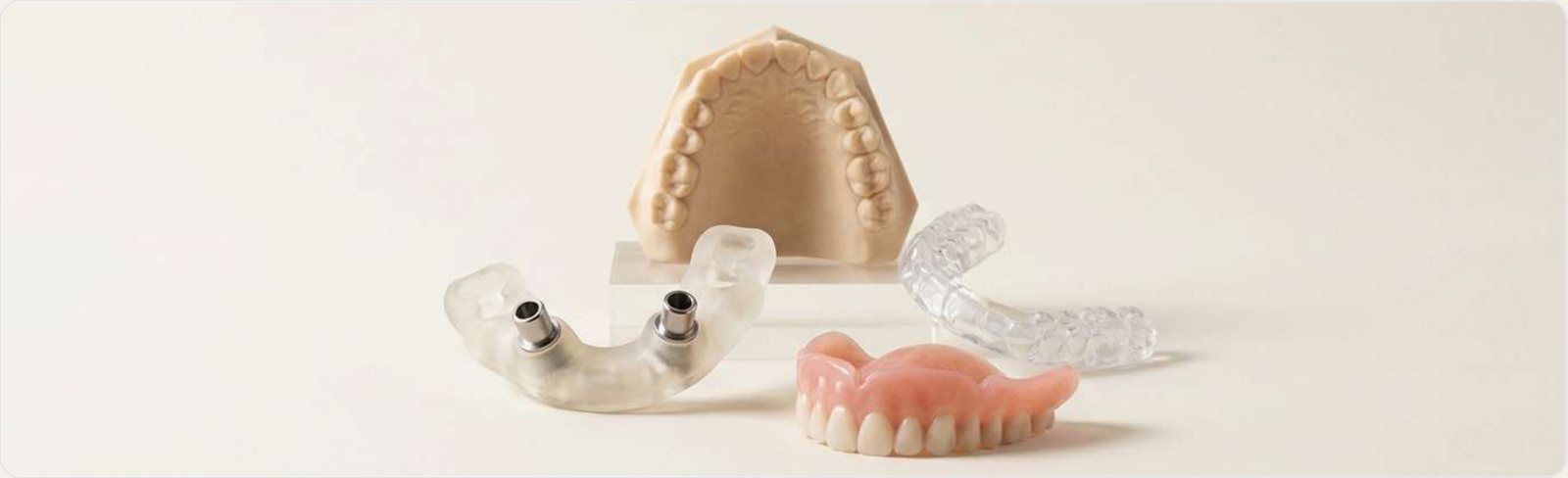
What we print
Six application families, each with its own material and tolerance requirements. The printer is rarely the interesting part — the interesting part is whether the file, the library and the physical components agree before anything is produced.
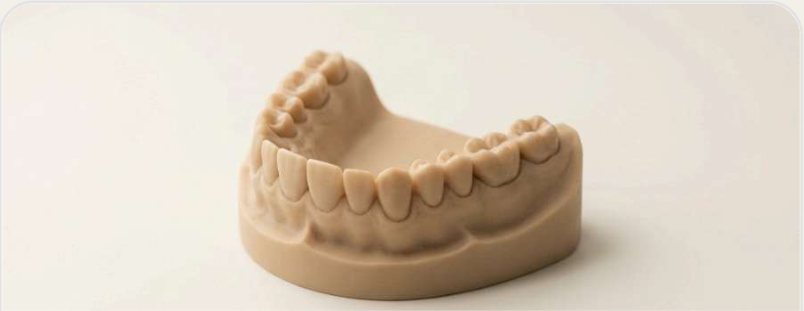
Dental models
Accurate working models for restorative cases, printed from your scan or ours.
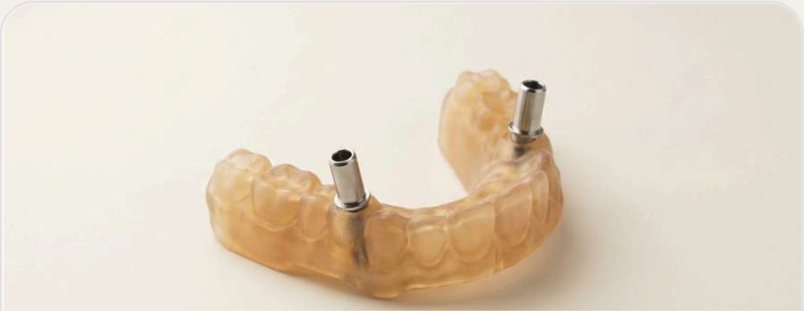
Surgical guides
Tooth-, mucosa- or bone-supported, printed to the plan with sleeves seated.
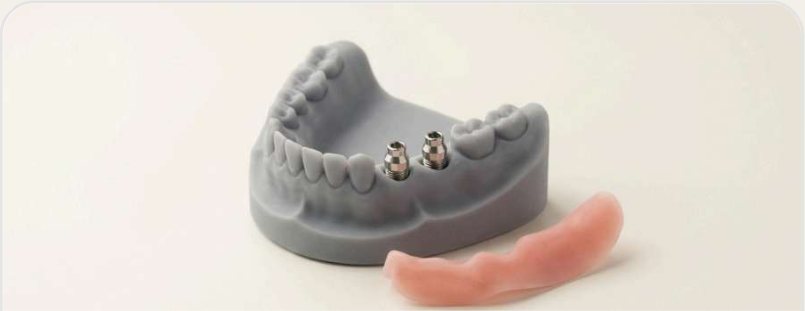
Implant models
Analog-ready, with removable gingival mask where the case calls for one.
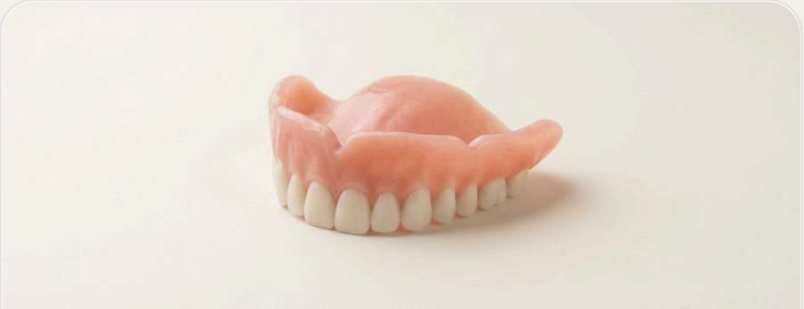
Digital dentures
Bases and try-ins, reproducible from a stored file rather than a stored cast.
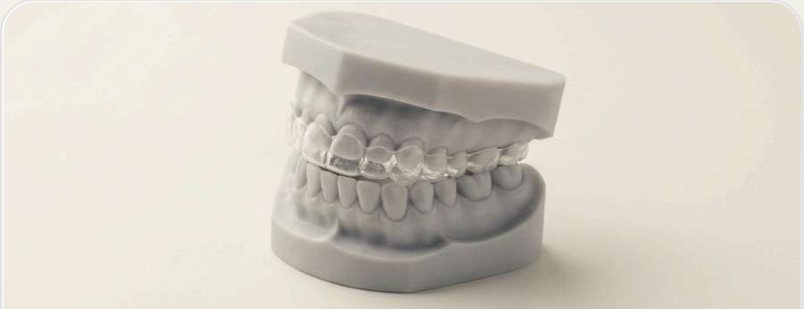
Orthodontic models
Aligner and appliance production models, printed in series.
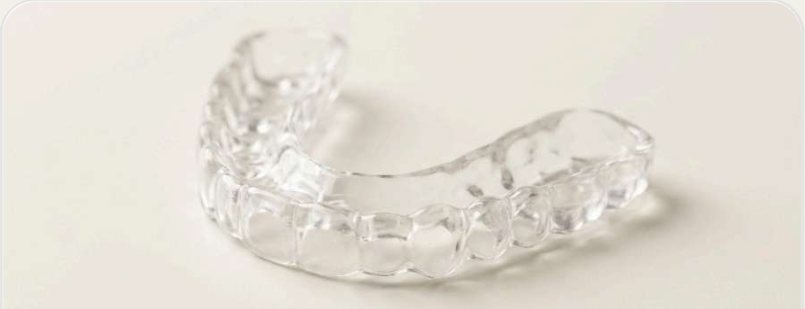
Night guards and splints
Direct-printed occlusal guards, finished and patient-ready.
Surgical guides
Guided placement is not a marginal gain. Pooled across 67 studies and 5,673 implants, guided surgery averages 1.11 mm coronal, 1.40 mm apical and 3.51° of deviation, against freehand angular deviation ranging 3.18–10.04°. Implant failure runs 2.25% guided versus 6.42% freehand.
Two things worth knowing before you buy guided anything. First, fully guided beats pilot-guided by a real margin — 0.33 mm coronal, 0.44 mm apical and 3.29°, all statistically significant. Second, static guides and dynamic navigation are statistically tied, so navigation is a workflow choice rather than an accuracy upgrade.
And a limit nobody selling guides mentions: the sleeve-to-drill mechanical tolerance alone contributes roughly 2.57° of angular error, independent of planning or technique. Against observed totals of 4–5°, that is a large share of the budget — which is why guide design, support type and pinning matter more than the planning software.
Models and implant models
Printed models report trueness broadly in the 20–50 µm range — inside the tolerance restorative work needs. On implant models the number that decides the case is different: the analog has to match the library, and the library has to match the scan body that was actually in the mouth.
Misfit tolerances are documented but not settled. One systematic review found no mechanical complications below roughly 150–160 µm, with biological thresholds far higher; a later review concluded the literature still cannot define a clinical threshold. Treat anyone quoting a single hard number with suspicion — including us.
Where a system's library is missing, outdated or simply wrong, the model is not the problem to solve first. That is what our implant library reference exists for.
Digital dentures
Of everything on this page, digital dentures have the clearest case. A twelve-month crossover randomised trial of 40 patients found digital dentures significantly better on comfort, retention and mastication, needing a median of one adjustment visit against two, with 70% of patients preferring the digital denture.
The structural argument is stronger still. Denture work is the most technician-dependent service in dentistry, and a digital workflow shifts that labour onto software and equipment. Where skilled prosthetic technicians are scarce — which is most places — that is the difference between a service you can offer reliably and one that depends on who is available that week. And because the denture exists as a file, a replacement is a reprint rather than a remake from scratch.
One honest counterpoint: going fully digital is not automatically better. At least one study found bases made from conventional impressions were two to three times more retentive than those from intraoral scans. On resorbed or flabby ridges a hybrid workflow that keeps a physical impression can outperform the fully digital one, and we will say so when that is the case.
Splints, guards and orthodontic models
Direct-printed occlusal guards come off the plate patient-ready, and orthodontic models print in series for aligner and appliance production.
If aligners are the reason you are printing: the economics turn on case length. In-house production is generally cheaper for short cases and outsourcing wins beyond roughly 22–26 aligner pairs, as volume discounts overtake marginal production cost. Worth modelling honestly before buying equipment, because published movement accuracy averages around 41% and more than 70% of cases need at least one refinement round — a business case built on a single shipment per patient will not survive contact with that number.
From smile simulation to printed mock-up
For aesthetic cases we can produce a photorealistic simulation from two clinical photographs, so the patient sees the planned result before treatment starts. Typical return is 24 hours.
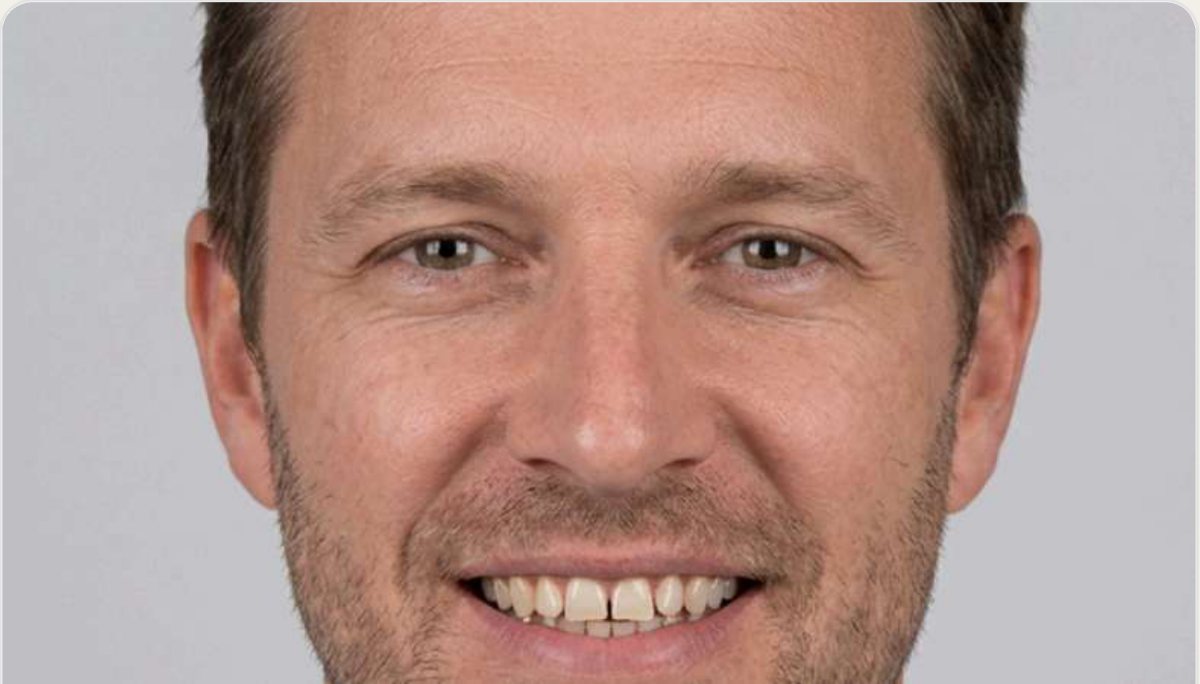
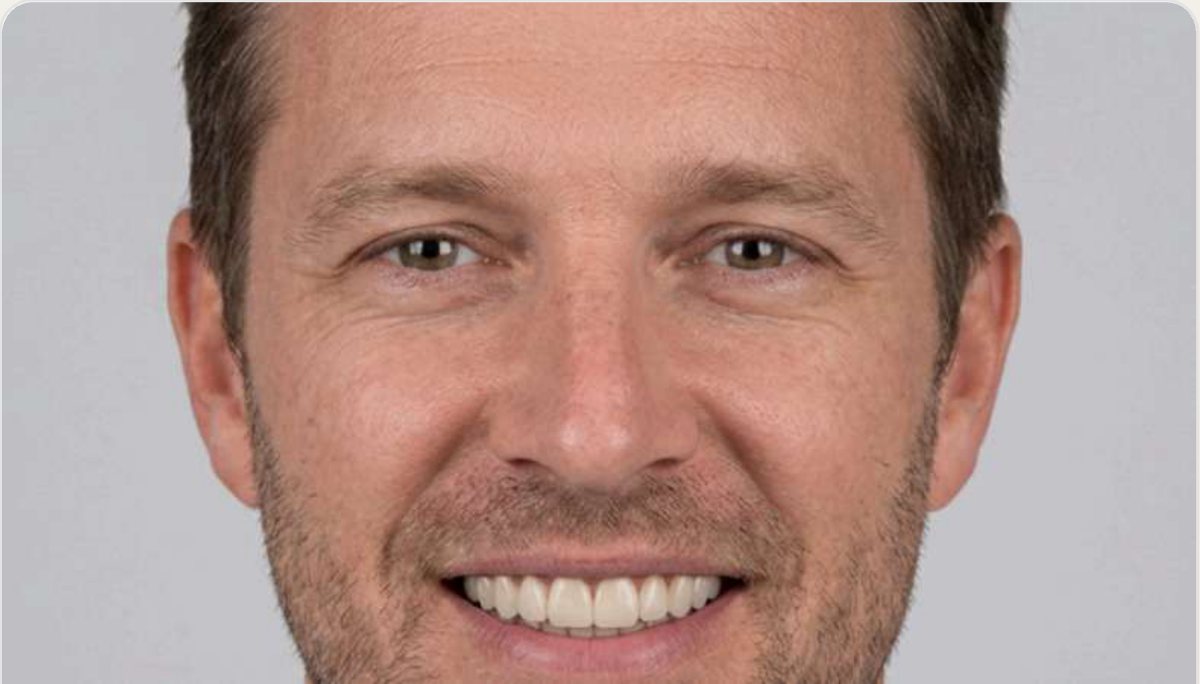
Illustrative simulation, not a treated case.
The reason this sits on a printing page rather than a marketing one: once the patient accepts the plan, the same design carries straight through to a printed diagnostic mock-up, then to guides and models. One continuous digital case, no re-drawing at each handoff.
Two things we will not claim. Simulations are planning and communication tools — the published evidence supports improved case acceptance and patient understanding, not better marginal fit or restoration survival. And we keep simulations clinically achievable rather than idealised, because a preview the case cannot deliver is worse than no preview at all.
How it works
Send an intraoral scan export or a finished CAD file. If the case needs designing, that happens first and you approve it before anything is produced — the same design workflow described on our CAD design services page. Printing, finishing and dispatch follow. For how printing fits the wider clinic-and-lab loop, see the digital dental lab guide.
Printing is materially cheaper to enter than milling and has no cutting-tool consumable, which is why it is usually the first digital production step a lab or clinic takes. Milling still wins on trueness and marginal fit for demanding restorative work, and remains the route for multi-unit frameworks and high-load posterior zirconia. We will tell you which one your case wants.
Library sources by implant system
Printing an implant case depends on the library and the analog agreeing with the scan body. These directory pages document where each system's official exocad and 3Shape libraries live, who else covers them, and what is known to go wrong — every fact source-linked.
- Straumann BLX / BL (Bone Level)
- Nobel Biocare Conical Connection (NobelActive / NobelParallel CC)
- Astra Tech Implant System EV
- Zimmer Tapered Screw-Vent (TSV)
- BioHorizons Tapered Internal
- Neodent Grand Morse
- MegaGen AnyRidge
- Osstem TS / Hiossen ET
Full index on the implant libraries reference.
Frequently asked questions
Is a printed restoration as durable as a milled one?
Not yet, and anyone who tells you otherwise is selling something. Independent testing puts current ceramic-filled printable resins at roughly 128–144 MPa flexural strength against 155–245 MPa for milled composite blocks, with markedly lower stiffness and hardness. Printed definitive single units have two-year prospective data showing acceptable clinical performance; printed three-unit bridges have shown connector fractures at one year. What we print is models, guides, appliances and denture bases — and where a case wants a definitive milled restoration instead, we will say so rather than print it because printing is what we happen to own.
What accuracy should I expect from a printed model?
Reported trueness for printed dental restorations and models generally falls in the 20–50 µm range, which is inside the tolerance most restorative work needs. The number that actually decides whether a case seats is not the printer, though — it is whether the scan, the library and the physical components agree. A perfectly printed model of the wrong library still produces a restoration that does not fit.
Do you need my STL, or can you work from the raw scan?
Either. Send the export from your scanner or your CAD file. If you send a raw intraoral scan we will design first — see our CAD design services — and confirm the design with you before anything reaches the printer.
How do you handle sterilisation of surgical guides?
Guides are printed in a biocompatible resin and supplied ready for your own sterilisation protocol. Worth knowing: sterilisation can affect dimensional accuracy, and the effect is material-dependent — one study found steam sterilisation measurably reduced the accuracy of resin templates while metal was unaffected, and another found autoclaving at 121°C for 20 minutes produced the least distortion across ten materials. We will tell you which resin your guide is printed in so your protocol can be validated against it rather than assumed.
Can you print for an implant system you have not worked with before?
Usually. The constraint is almost never the printer — it is whether a usable library and a matching analog exist for that system. That is the same problem our implant library work exists to solve, so if the library is missing or wrong we can tell you before the case starts rather than after the model is on the bench.